


Maximizing Fine Copper Recovery from IBA Using Gravity Separation
.png) In the economics of Incineration Bottom Ash (IBA) processing, volume and value are two very different metrics. While ferrous metals (iron and steel) make up the vast majority of the recovered volume, non-ferrous and heavy metals—specifically copper and trace precious metals (gold, silver)—drive the highest profit margins.
In the economics of Incineration Bottom Ash (IBA) processing, volume and value are two very different metrics. While ferrous metals (iron and steel) make up the vast majority of the recovered volume, non-ferrous and heavy metals—specifically copper and trace precious metals (gold, silver)—drive the highest profit margins.
Most modern Waste-to-Energy (WtE) sorting plants easily capture large copper pipes or brass fittings using Eddy Current Separators (ECS). However, a significant portion of the copper in municipal solid waste exists as ultra-fine particles (e.g., chopped electrical wires, shredded electronics). These micro-fine heavy metals frequently escape magnetic and induction fields, washing away into the residual sludge.
To truly maximize plant ROI and achieve zero waste to landfill, operators must deploy a secondary recovery stage: Wet Gravity Separation. In this technical guide, we will explore why fine copper evades standard sorting, the mechanics of gravity separation, and how integrating Jigs and Shaking Tables into your plant can capture the highest-value materials hidden in your bottom ash.
1. The Blind Spot: Why Eddy Currents Miss Fine Copper
Eddy Current Separators are the undisputed kings of recovering Aluminum (ZORBA). But when it comes to fine copper (< 5mm), their efficiency drops sharply. Why does this happen?
- ✖ The Conductivity-to-Density Ratio ($\sigma/\rho$): An ECS repels metal based on its electrical conductivity relative to its mass. Aluminum is highly conductive and very light, resulting in a massive repulsive throw. Copper is highly conductive, but it is three times denser than aluminum. For large copper pieces, the ECS works fine. But for tiny copper wires (where mass is minuscule but aerodynamic drag is high), the Lorentz force is often insufficient to eject the particle out of the heavy, wet slag flow.
- ✖ Particle Geometry: Copper often appears in IBA as long, thin wires. Depending on how the wire hits the magnetic field, the induced eddy currents may not generate a strong enough opposing field for ejection.
- ✖ Stainless Steel and Lead: These valuable heavy metals have very poor electrical conductivity. An ECS will practically ignore them, causing them to drop into the inert aggregate bin.
2. The Solution: Mechanics of Gravity Separation
When electromagnetism fails, we turn to the most fundamental physical property: Specific Gravity (Density). Gravity separation utilizes the interaction between a particle's mass, fluid dynamics (water), and mechanical vibration to separate materials.
In a wet IBA sorting line, the inert slag (glass, ceramics, melted ash) generally has a specific gravity of around 2.2 to 2.8 g/cm³. In stark contrast, Copper has a specific gravity of 8.9 g/cm³, Lead is 11.3 g/cm³, and Gold is a massive 19.3 g/cm³. This massive difference in density makes gravity separation incredibly effective for recovering heavy non-ferrous metals, regardless of their particle size or electrical conductivity.
3. Core Equipment: Jigs vs. Shaking Tables
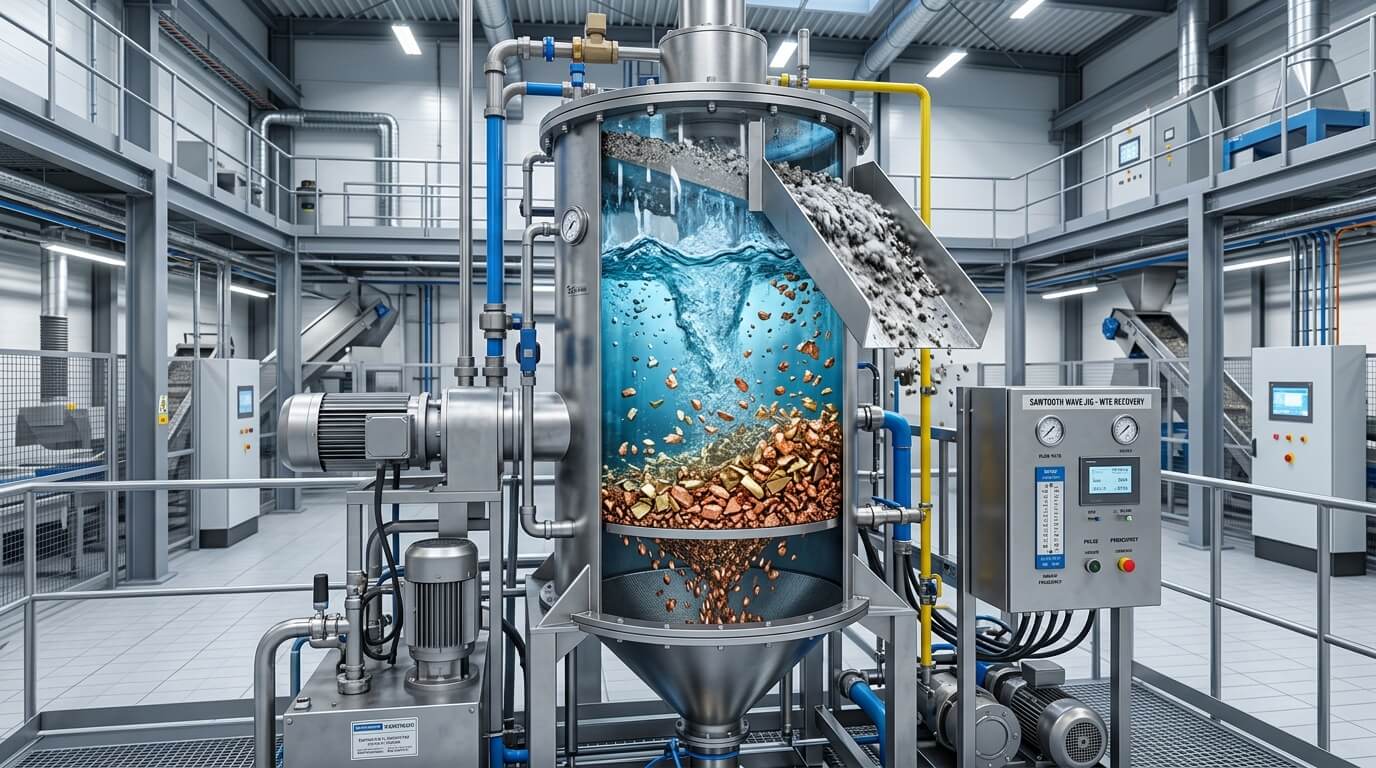
To recover heavy metals from varying fractions of bottom ash, WtE plants typically deploy two types of specialized gravity separators. Selecting the right equipment depends entirely on the particle size of the feed material.
| Feature | Sawtooth Wave Jig | 6-S Shaking Table |
|---|---|---|
| Target Particle Size | 2.0 mm to 30 mm (Coarse to Medium) | 0.022 mm to 2.0 mm (Micro-Fine) |
| Separation Mechanism | Vertical water pulsation (fluidized bed expansion). Heavy metals sink through the screen bed. | Asymmetric horizontal vibration with a thin film of transverse water. Heavy metals grip the table rifling. |
| Processing Capacity | High (Up to 20-30 t/h per unit) | Low (approx. 1 to 1.5 t/h per deck) |
| Best Use Case in IBA | Recovering chunky copper, brass fittings, and heavy stainless steel from the mid-fraction slag. | Scavenging gold, silver, and microscopic copper wire dust from the final sludge before the filter press. |
| Footprint | Compact (Vertical orientation) | Large (Requires significant horizontal floor space) |
4. Crucial Prerequisites: Desliming and Iron Removal
Gravity separators are highly sensitive instruments. If you pump raw, untreated IBA slurry directly onto a Shaking Table or into a Jig, the separation process will fail entirely. The feed material must be strictly pre-conditioned.
1. Strict Sizing via Screens
Gravity separation relies on the difference in falling velocity between particles. If a large piece of light glass and a tiny piece of heavy copper fall at the same speed, the machine cannot separate them. Therefore, operators must use Trommel Screens and high-frequency vibrating screens to divide the ash into very tight size fractions (e.g., 0-2mm, 2-8mm) before feeding it to the gravity equipment.
2. Ferrous Dust Removal
This is the most common mistake made in IBA plants. Incinerator ash contains massive amounts of microscopic iron dust. Iron is very heavy (Density ~7.8 g/cm³). If this iron dust is pumped onto a 6-S Shaking Table, it will sink, fill up the rifling grooves, and prevent the copper and gold from being captured. A Wet Magnetic Separator or Fine Powder Iron Remover must be installed immediately before the gravity separators to extract this magnetic interference.
5. The ROI of Recovering "The Leftovers"
Many plant operators hesitate to install gravity separation circuits because the volume of metal recovered seems small compared to the massive tonnage of ferrous scrap pulled by overband magnets. However, evaluating this based on volume is a mistake; it must be evaluated on value.
Heavy non-ferrous concentrates (often referred to as "Heavy Heavies" in the recycling trade) consist of high-purity copper, brass, zinc, and precious metals. This fraction commands premium market prices, often exceeding $4,000 to $6,000 per ton. Capturing just an additional 0.2% to 0.5% of fine copper from a 100,000 TPD ash stream can add millions of dollars to a WtE plant's annual bottom line, paying off the CapEx of the Jig and Shaking Table circuit in a matter of months.
Capture the Highest Value Metals in Your Ash
If your sorting line relies solely on Eddy Currents, you are sending premium copper and precious metals to the landfill. IbaSorting designs integrated wet processing lines combining advanced ECS with precision Gravity Separation to guarantee zero loss of valuable commodities.
Learn more About Us and our mission to engineer a zero-waste future.
Frequently Asked Questions (FAQ)
What happens to the water used in the Jigs and Shaking Tables?
Gravity separation is a wet process, meaning it generates significant slurry. In a modern plant, the tailings (waste) overflow from these machines is piped directly to a thickener and then into our Sludge Filter Press. This creates a closed-loop system where the solids are compressed into dry cakes, and the clean water is recycled back to power the Jigs and Tables.
Can gravity separation recover Aluminum?
No. Aluminum is a lightweight metal with a specific gravity of approximately 2.7 g/cm³, which is almost identical to the inert glass and slag aggregate (2.5 - 2.8 g/cm³). Because their densities are so similar, water-based gravity separation cannot separate them. This is why a complete IBA plant requires both Eddy Current Separators (for the light Aluminum) and Gravity Separators (for the heavy Copper/Gold).