


How Eddy Current Separators Recover Non-Ferrous Metals from Slag: The Ultimate Technical Guide
In the highly profitable world of Incineration Bottom Ash (IBA) processing, the extraction of non-ferrous metals—specifically aluminum, copper, and zinc—represents the lion's share of a plant's revenue. The workhorse behind this extraction is the Eddy Current Separator (ECS).
However, sorting non-ferrous metals from Waste-to-Energy (WtE) slag is notoriously more difficult than sorting standard municipal recycling. IBA is dense, highly abrasive, often wet, and plagued by residual micro-iron dust that can destroy standard equipment in days. To succeed, operators must understand not just the basic physics of the ECS, but how advanced engineering—like eccentric rotors and multi-axis splitters—adapts this technology specifically for severe bottom ash environments.
In this deep-dive technical guide, we will explore the fundamental physics of the Lorentz force, dissect the anatomy of an industrial ECS, and explain exactly why standard recycling equipment fails in IBA applications. We will also detail how specialized Eddy Current Separators from IbaSorting overcome these extreme challenges to achieve recovery rates of ≥ 98%.
1. The Physics: How Does an Eddy Current Separator Work?
Unlike traditional magnetic separators that attract ferrous (iron) metals, an Eddy Current Separator repels non-ferrous metals based on their electrical conductivity. This phenomenon relies on Faraday's Law of Induction and the resulting Lorentz force.
The 4-Step Repulsion Process
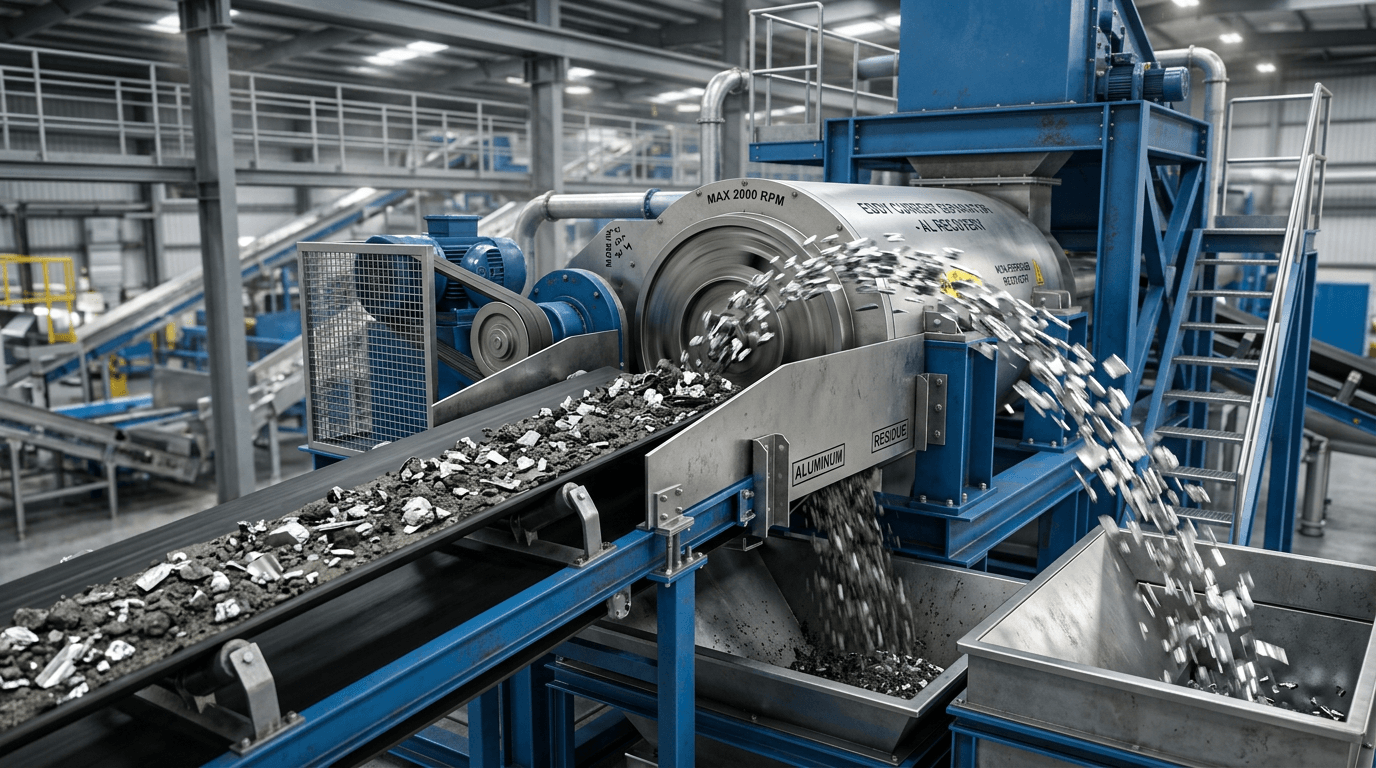
- The Alternating Field: Inside the head pulley of the conveyor belt is a rapidly spinning magnetic rotor (often turning at 3,000 to 4,000 RPM). This rotor consists of alternating North and South rare-earth (NdFeB) magnets. As it spins, it creates a high-frequency, alternating magnetic field.
- Induction (Faraday's Law): When a conductive non-ferrous metal (like a piece of aluminum slag) enters this rapidly changing magnetic field, circulating electrical currents—called "eddy currents"—are induced within the metal itself.
- The Opposing Field (Lenz's Law): According to Lenz's Law, these newly created eddy currents generate their own magnetic field, which is exactly opposite in polarity to the magnetic field that created them (the rotor).
- The Ejection (Lorentz Force): Because like magnetic poles repel each other, the opposing magnetic field pushes the piece of aluminum away. The metal is forcefully ejected in a forward trajectory, clearing a physical splitter plate, while inert materials (glass, stone, dry ash) simply fall vertically due to gravity.
2. The Critical Ratio: Conductivity vs. Density
Not all non-ferrous metals react the same way to an ECS. The force of the ejection depends on the material's electrical conductivity divided by its density ($ \frac{\sigma}{\rho} $). A higher ratio means the material is easily thrown; a lower ratio means it is difficult to separate.
| Metal | Conductivity (MS/m) | Density (g/cm³) | Ratio ($\sigma/\rho$) | ECS Separability |
|---|---|---|---|---|
| Aluminum | 37.8 | 2.7 | 14.0 | Excellent (Throws far) |
| Magnesium | 22.6 | 1.74 | 13.0 | Excellent |
| Copper | 59.6 | 8.9 | 6.7 | Good (Throws moderately) |
| Zinc | 16.9 | 7.1 | 2.4 | Fair |
| Stainless Steel (304) | 1.4 | 7.9 | 0.17 | Poor (Drops with slag) |
| Lead | 4.8 | 11.3 | 0.42 | Poor (Drops with slag) |
As the table shows, aluminum is easily ejected, forming the bulk of the ZORBA recovered in WtE plants. However, heavy metals with low conductivity, such as stainless steel and lead, simply do not generate enough repulsive force. To capture these heavy metals from the remaining slag, plants must employ secondary gravity separation techniques, utilizing Sawtooth Wave Jigs and 6-S Shaking Tables.
3. The IBA Challenge: Why Standard ECS Units Burn Out
When processing clean plastics or wood, a standard ECS works perfectly. But Incineration Bottom Ash is entirely different. Even after passing under strong Overband Magnets, fine IBA always contains residual micro-iron dust and weakly magnetic particles.
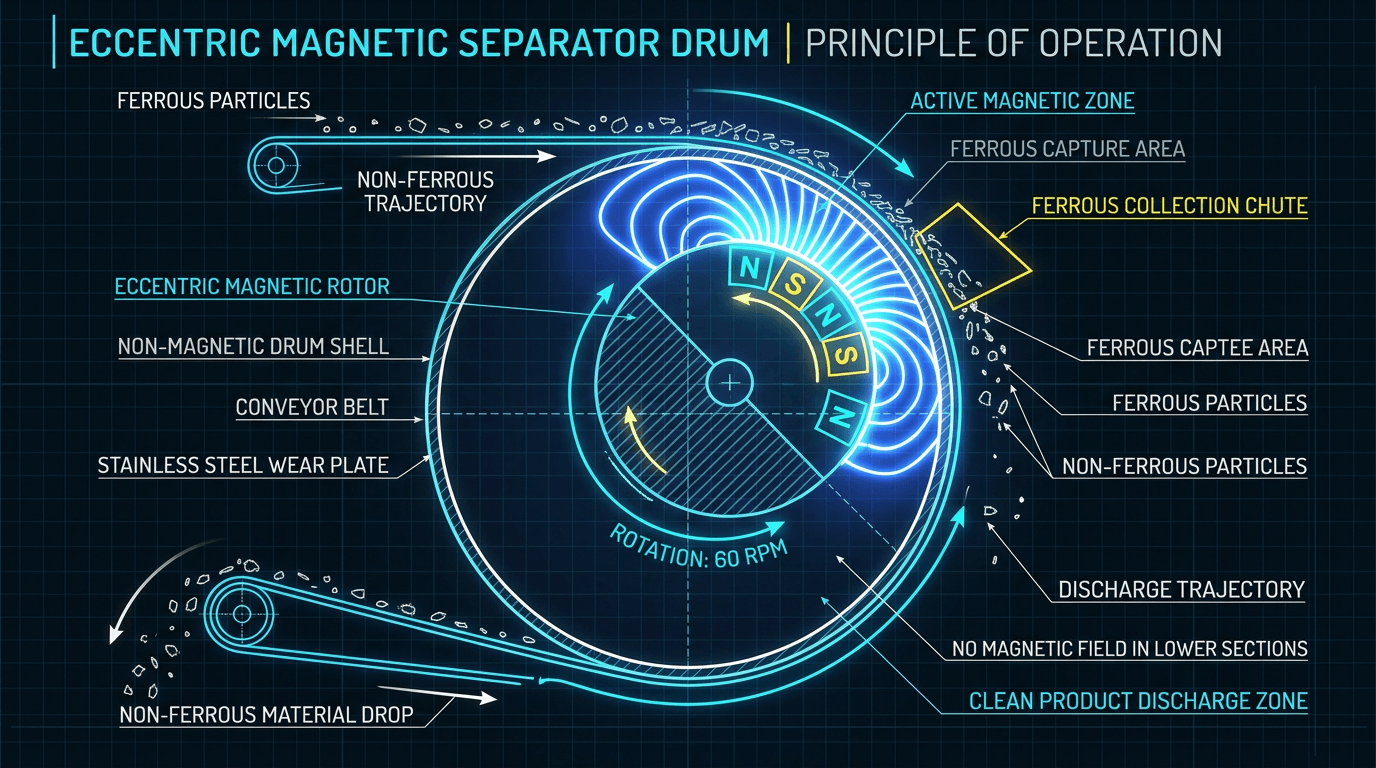
In a standard Concentric Rotor ECS (where the spinning magnetic rotor sits exactly in the center of the outer drum), the magnetic field surrounds the entire drum. If iron dust reaches the drum, it gets permanently trapped in this 360-degree magnetic field. As the rotor spins at 3,000 RPM, it continuously drags this trapped iron dust against the inside of the Kevlar belt. The resulting magnetic friction generates extreme heat, causing the belt to literally melt and catch fire within hours.
The Solution: The Eccentric Rotor Design
To process bottom ash safely, high-end ECS units utilize an Eccentric Rotor.
- ✔Offset Magnetic Field: The internal high-speed rotor is positioned off-center, pushed towards the upper-front quadrant of the drum. This focuses the intense alternating magnetic field exactly at the point where the material leaves the belt.
- ✔The "Drop-Off" Zone: Because the rotor is off-center, the magnetic field strength drops to zero at the bottom of the drum. Any residual iron dust that gets stuck to the belt simply falls away harmlessly when it reaches the bottom, preventing friction, heat, and belt fires.
4. Prerequisites for High Metal Recovery in WtE Plants
An Eddy Current Separator is a precision instrument. To achieve recovery rates of ≥ 98%, the feed material must be meticulously prepared. Dumping raw slag directly onto an ECS will result in disastrously low yields.
- Strict Sizing (The Rule of 3): The repulsive Lorentz force competes with gravity and mass. If you feed a 50mm heavy glass chunk alongside a 5mm light aluminum flake, the trajectories overlap, ruining separation. The golden rule in IBA sorting is that the ratio of upper to lower grain size should not exceed 3. For example, use Trommel Screens to pre-screen the slag into strict fractions: 5-15mm, 15-45mm, etc.
- Monolayer Feeding: If slag is stacked on top of each other, an ejected piece of aluminum will hit a piece of glass above it and fall into the waste pile. You must use an Electromagnetic Vibrating Feeder to deliver a single, uniform, one-particle-deep layer of slag onto the ECS belt.
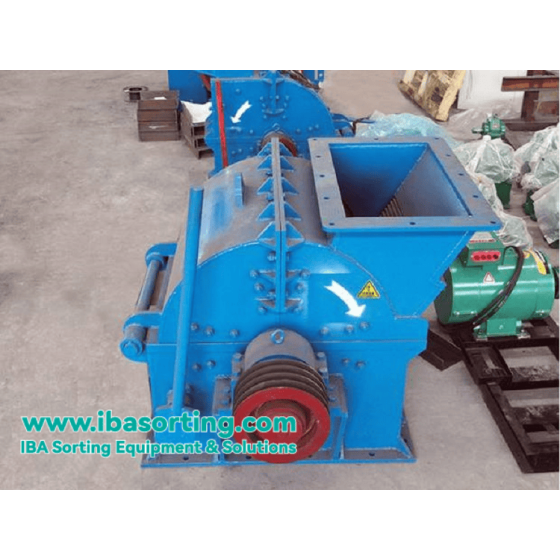
- Metal Liberation: In WtE ash, metals are often fused inside ceramic clinkers. An ECS cannot repel a piece of aluminum if it is encased in 2 inches of heavy glass. Specialized Slag Crushers are mandatory to shatter the slag and expose the bare metal before it reaches the ECS.
Optimize Your Non-Ferrous Recovery
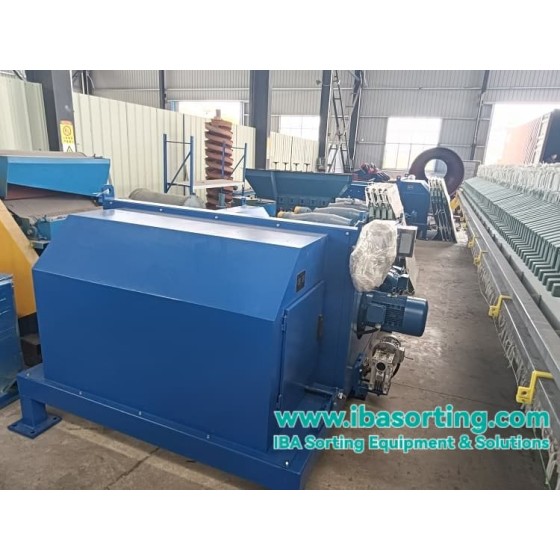
Are you losing valuable ZORBA and fine copper to the landfill due to inefficient sorting technology? IbaSorting designs and manufactures heavy-duty, eccentric-rotor Eddy Current Separators specifically engineered for the harsh realities of WtE bottom ash.
Discover how our equipment integrates into Complete Turnkey Sorting Plants.
Frequently Asked Questions (FAQ)
How does moisture affect Eddy Current Separation in wet IBA plants?
Wet processing actually improves metal recovery by washing off the "cement crust" that typically coats metals in dry ash, allowing the magnetic field to penetrate better. However, wet slag is sticky. Our specialized ECS units for wet plants feature multi-axis adjustable splitter plates to account for the slightly altered, "sticky" trajectory of wet non-ferrous metals, ensuring high purity.
Can one ECS handle all sizes of bottom ash?
No. To achieve high efficiency, you need different magnetic pole configurations. A "coarse pole" ECS with deeper magnetic penetration is used for large slag (e.g., 20-50mm), while a "fine pole" ECS with a higher frequency of magnetic alternations is required to repel tiny, low-mass metal particles (e.g., 2-10mm).